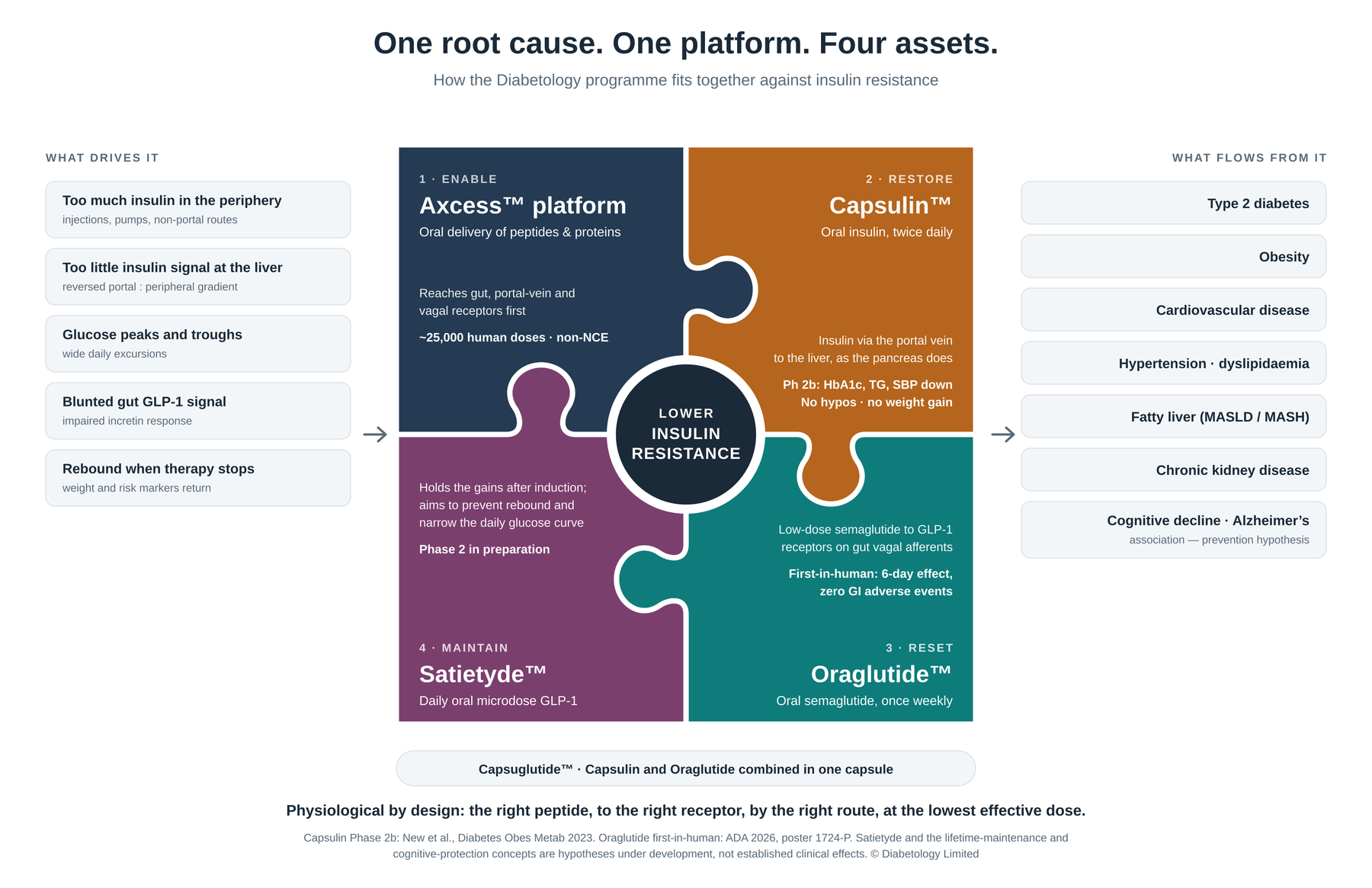
The right peptide, to the right receptor, by the right route

Insulin and GLP-1 are the body’s own signals, and both normally act first on targets upstream of the general circulation: the liver and the nerve endings in the gut wall. Injection delivers them somewhere else. Axcess is the platform that makes the physiological route available by mouth – and it is why our licensees four different assets can be built on one to our axcess technology.

Axcess™ oral delivery platform exclusively
licensed by Diabetology for diabetes and obesity

The platform

What Axcess is

Axcess is a formulation system that carries peptides and proteins intact through the stomach and delivers them across the wall of the small intestine. The excipients inhibit the enzymes that would otherwise digest the payload, open the mucin layer that would block it, and promote uptake into the cells lining the intestine. They are materials with established safety records, and the payloads themselves are not new chemical entities.

~25,000

human administrations of the Axcess system across the programme to date.

2

peer-reviewed clinical papers in Diabetes, Obesity and Metabolism.[11]

4

assets built on the one platform: Capsulin™, Oraglutide™, Satietyde™ and Capsuglutide™.

Non-NCE

The molecules are established medicines. What is new is the route and the site of action.
Because Axcess encapsulates its payload physically rather than chemically, more than one peptide can travel in the same capsule. That is what makes Capsuglutide — insulin and semaglutide together — possible without reformulating either molecule.

Route

Why the compartment decides the outcome

The pancreas secretes insulin into the portal vein, and the liver extracts roughly half of it on first pass.[5] Portal concentrations are normally two to three times peripheral concentrations, and insulin’s direct hepatic action dominates the control of glucose production.[6] Every non-portal route — subcutaneous injection, pump, inhaled, transdermal, buccal, sublingual — inverts that gradient, so that peripheral tissues must be over-exposed in order to reach the liver at all.[8]
Physiological route — the pancreas, and Capsulin™
Pancreas / intestine
insulin enters here
Portal vein

high insulin

LIVER
first target · extracts about half
Peripheral tissues
low insulin

Portal-to-peripheral gradient of roughly 2–3 : 1. The liver sees the signal first; muscle and fat see what is left.

Non-physiological routes — injection, pump, transdermal, inhaled, buccal or sublingual
Skin, lung or mouth
insulin enters here
Peripheral circulation
high insulin
Muscle, fat, vessels
over-exposed
LIVER
under-insulinised

Gradient reversed. To control the liver, the periphery must be overdosed: hypoglycaemia, weight gain and peripheral insulin resistance follow.

Insulin is life-saving. The argument is about the route, not the molecule.

Intestinal absorption returns insulin to its original path. That is the mechanism behind the Phase 2a clamp study, in which oral Capsulin lowered glucose with markedly lower peripheral insulin concentrations than subcutaneous regular insulin,[11] and behind the Phase 2b finding that glucose fell without hypoglycaemia or weight gain.[12]

Target

GLP-1 is a local gut signal, not a blood-borne one

Native GLP-1 is released from intestinal L-cells after a meal and is degraded within one to two minutes; only a small fraction reaches the general circulation intact.[14] Much of its physiological action is therefore exerted close to where it is released — on GLP-1 receptors on vagal nerve endings in the gut wall and the portal region. Knocking down those receptors in animals raises food intake and post-meal glucose,[16] and portal-vein receptors mediate part of the effect of endogenous GLP-1 on glucose tolerance.[17] The signal is weaker in the people who need it most: the GLP-1 response to a meal is blunted in obesity,[18] and an impaired incretin response tracks with insulin resistance in non-diabetic men.[19]

Current GLP-1 medicines take a different path. They rely on sustained high concentrations in the bloodstream to reach the pancreas and the brain. They work[25] — but they bring nausea, dose titration and widespread discontinuation with them, and the benefit reverses when treatment stops.[26,28]

Rhythm

Weekly administration of Oraglutide may have an unexpected additional benefit of Intermittency

And a low dose, low side effect daily oral semaglutide could have a significant role in addressing 'rebound'

Continuous stimulation of the GLP-1 receptor may desensitise the vagally mediated arm of its action. Nauck and colleagues showed the deceleration of gastric emptying fading within about five hours of continuous infusion, with a parallel loss of the pancreatic polypeptide response that locates the effect at the level of vagal activation.[20] Comparisons of prolonged with intermittent stimulation show that intermittent exposure preserves what continuous exposure loses.[21] The current expert view is that tachyphylaxis of this arm is partial rather than complete, and that short-acting agents retain a larger effect than long-acting ones.[22]

Injected semaglutide, weekly

Half-life about 7 days. Weekly dosing accumulates to steady state with little peak-to-trough movement: continuous occupancy.

Oral semaglutide with SNAC, daily

Apparently absorbed across the stomach mucosa and taken every day: also, in effect, continuous occupancy.

Oraglutide™, weekly
Half-life about 48 hours. Weekly dosing leaves roughly three and a half half-lives of washout between doses: an intermittent profile.

Hypothesis under test: intermittent exposure may preserve gut–vagal effects that continuous agonism desensitises.

This is an inference from pharmacokinetics. It has not yet been demonstrated in a clinical study.

This prediction is testable, and testing it is part of the Oraglutide Phase 2 programme: gastric emptying measured early and again at week 12, against a continuous-exposure comparator.

The pipeline on one platform

One Axcess Delivery technology, spawns four assets & one potential integrated solution to insulin resistance

Each asset answers a different part of the problem. Capsulin supplies insulin the beta cell can no longer make, by the portal route. Oraglutide reaches the gut–vagal target at low systemic exposure. Satietyde is designed for maintenance. Capsuglutide combines the first two.

Asset What it is Primary target Stage
Capsulin™
Human insulin, twice daily
Liver, via the portal vein
Phase 2b complete; Phase 3 in preparation
Oraglutide™
Semaglutide, low dose, once weekly
Intestinal and portal vagal GLP-1 receptors
First-in-human complete; Phase 2 under way
Satietyde™
Lipidated GLP-1 agonist, daily microdose
As Oraglutide, at maintenance exposure
Phase 2 in preparation
Capsuglutide™
Insulin and semaglutide in one capsule
Liver and gut–brain axis together
First-in-human in preparation

Why it matters at scale

One Axcess Delivery technology, spawns four assets & one potential integrated solution to insulin resistance

The diseases downstream of insulin resistance are among the largest line items in every developed health system. Diagnosed diabetes cost the United States $412.9 billion in 2022, one in four health care dollars.[41] Overweight and obesity are projected to cost the world $4.32 trillion a year by 2035, about 3% of global GDP.[42] Dementia already costs more than $1.3 trillion a year worldwide.[43]

Set against that, interventions that delay progression have historically represented good value. In the Diabetes Prevention Program, the lifestyle arm gained 0.14 quality-adjusted life years per person over 10 years at a discounted cost of roughly $10,000–$13,000 per QALY, and was cost-saving in people under 45.[44] Applied arithmetically to a million adults, that is about 140,000 QALYs and roughly $4.3 billion in avoided direct medical costs over a decade.

Read that as scale, not as a claim. Those numbers come from an intensive lifestyle programme, not from our products, and none of these outcomes has been demonstrated for any Axcess-based asset. They are set out here because they describe the size of the problem a successful oral platform would be addressing. A fuller version of this model, with each input sourced, is on the Diabetology website.

Three features of the platform bear directly on that value. Oral administration removes the needle, the device and the cold chain, which decides whether a therapy can be offered in primary care and in lower-income countries. A microdose maintenance product uses a small fraction of the active ingredient of an injectable course. And because the molecules are established medicines rather than new chemical entities, the development path starts from a known safety package.

Status of the evidence

Where the platform stands

Demonstrated in humans
  • Oral Capsulin lowers glucose at lower peripheral insulin than subcutaneous insulin (isoglycaemic clamp)[11]
  • Oral Capsulin lowers HbA1c and fasting glucose with no hypoglycaemia and no weight gain, and lowers triglycerides and systolic pressure (Phase 2b)[12]
  • A single 4 mg oral semaglutide capsule acts for six days with no gastrointestinal adverse events (first-in-human, n = 8)[24]
Still to be established
  • Direct measurement of insulin resistance under Capsulin therapy
  • That the vagal mechanism proposed for Oraglutide operates in humans
  • That intermittent exposure preserves responsiveness over 12 weeks
  • Maintenance efficacy and optimal schedule for Satietyde
  • That low-dose gut-directed delivery reproduces outcomes obtained at full systemic exposure

Capsulin is subject to an FDA clinical hold pending two defined non-clinical studies concerning a manufacturing batch and an excipient. The hold does not relate to any clinical efficacy or safety finding.

References

Sources cited on this page

  1. Reaven GM. Banting Lecture 1988. Role of insulin resistance in human disease. Diabetes. 1988;37(12):1595–1607.
  2. Araújo J, Cai J, Stevens J. Prevalence of optimal metabolic health in American adults: NHANES 2009–2016. Metab Syndr Relat Disord. 2019;17(1):46–52.
  3. Parcha V, Heindl B, Kalra R, et al. Insulin resistance and cardiometabolic risk profile among nondiabetic American young adults: insights from NHANES. J Clin Endocrinol Metab. 2022;107(1):e25–e37.
  4. International Diabetes Federation. IDF Diabetes Atlas. 11th ed. Brussels: IDF; 2025.
  5. Eaton RP, Allen RC, Schade DS. Hepatic removal of insulin in normal man: dose response to endogenous insulin secretion. J Clin Endocrinol Metab. 1983;56(6):1294–1300.
  6. Edgerton DS, Lautz M, Scott M, et al. Insulin’s direct effects on the liver dominate the control of hepatic glucose production. J Clin Invest. 2006;116(2):521–527.
  7. Gregory JM, Smith TJ, Slaughter JC, et al. Iatrogenic hyperinsulinemia, not hyperglycemia, drives insulin resistance in type 1 diabetes as revealed by comparison with GCK-MODY. Diabetes. 2019;68(8):1565–1576.
  8. Gregory JM, Cherrington AD, Moore DJ. The peripheral peril: injected insulin induces insulin insensitivity in type 1 diabetes. Diabetes. 2020;69(5):837–847.
  9. Del Prato S, Leonetti F, Simonson DC, et al. Effect of sustained physiologic hyperinsulinaemia and hyperglycaemia on insulin secretion and insulin sensitivity in man. Diabetologia. 1994;37(10):1025–1035.
  10. Henry RR, Gumbiner B, Ditzler T, et al. Intensive conventional insulin therapy for type II diabetes: metabolic effects during a 6-mo outpatient trial. Diabetes Care. 1993;16(1):21–31.
  11. Luzio SD, Dunseath G, Lockett A, Broke-Smith TP, New RR, Owens DR. The glucose lowering effect of an oral insulin (Capsulin) during an isoglycaemic clamp study in persons with type 2 diabetes. Diabetes Obes Metab. 2010;12(1):82–87.
  12. New RRC, Ramanujam S, Chaudhari V, Bogus M, Travers GN, Namjoshi G. Safety and efficacy of an oral insulin (Capsulin) in patients with early-stage type 2 diabetes: a dose-ranging phase 2b study. Diabetes Obes Metab. 2023;25(4):953–960.
  13. McLaughlin T, Reaven G, Abbasi F, et al. Is there a simple way to identify insulin-resistant individuals at increased risk of cardiovascular disease? Am J Cardiol. 2005;96(3):399–404.
  14. Holst JJ. The physiology of glucagon-like peptide 1. Physiol Rev. 2007;87(4):1409–1439.
  15. Drucker DJ. Mechanisms of action and therapeutic application of glucagon-like peptide-1. Cell Metab. 2018;27(4):740–756.
  16. Krieger JP, Arnold M, Pettersen KG, et al. Knockdown of GLP-1 receptors in vagal afferents affects normal food intake and glycemia. Diabetes. 2016;65(1):34–43.
  17. Vahl TP, Tauchi M, Durler TS, et al. GLP-1 receptors expressed on nerve terminals in the portal vein mediate the effects of endogenous GLP-1 on glucose tolerance in rats. Endocrinology. 2007;148(10):4965–4973.
  18. Ranganath LR, Beety JM, Morgan LM, et al. Attenuated GLP-1 secretion in obesity: cause or consequence? Gut. 1996;38(6):916–919.
  19. Rask E, Olsson T, Söderberg S, et al. Impaired incretin response after a mixed meal is associated with insulin resistance in nondiabetic men. Diabetes Care. 2001;24(9):1640–1645.
  20. Nauck MA, Kemmeries G, Holst JJ, Meier JJ. Rapid tachyphylaxis of the glucagon-like peptide 1-induced deceleration of gastric emptying in humans. Diabetes. 2011;60(5):1561–1565.
  21. Umapathysivam MM, Lee MY, Jones KL, et al. Comparative effects of prolonged and intermittent stimulation of the glucagon-like peptide 1 receptor on gastric emptying and glycemia. Diabetes. 2014;63(2):785–790.
  22. Jalleh RJ, Plummer MP, Marathe CS, et al. Clinical consequences of delayed gastric emptying with GLP-1 receptor agonists and tirzepatide. J Clin Endocrinol Metab. 2025;110(1).
  23. Overgaard RV, Hertz CL, Ingwersen SH, Navarria A, Drucker DJ. Clinical pharmacokinetics of oral semaglutide. Clin Pharmacokinet. 2021;60(10):1335–1348.
  24. Diabetology Limited. First-in-human study of a single 4 mg dose of an intestinally absorbed oral semaglutide formulation (Oraglutide). Poster 1724-P, American Diabetes Association 86th Scientific Sessions; June 2026.
  25. Wilding JPH, Batterham RL, Calanna S, et al. Once-weekly semaglutide in adults with overweight or obesity. N Engl J Med. 2021;384(11):989–1002.
  26. Wilding JPH, Batterham RL, Davies M, et al. Weight regain and cardiometabolic effects after withdrawal of semaglutide: the STEP 1 trial extension. Diabetes Obes Metab. 2022;24(8):1553–1564.
  27. Wharton S, Batterham RL, Bhatta M, et al. Two-year effect of semaglutide 2.4 mg on control of eating in adults with overweight or obesity: STEP 5. Obesity (Silver Spring). 2023;31(3):703–715.
  28. Gleason PP, Urick BY, Marshall LZ, et al. Real-world persistence and adherence to GLP-1 receptor agonists among obese commercially insured adults without diabetes. J Manag Care Spec Pharm. 2024;30(8):860–867.
  29. Gough SCL, Bode B, Woo V, et al. Efficacy and safety of a fixed-ratio combination of insulin degludec and liraglutide compared with its components given alone (DUAL I). Lancet Diabetes Endocrinol. 2014;2(11):885–893.
  30. Talchai C, Xuan S, Lin HV, Sussel L, Accili D. Pancreatic β-cell dedifferentiation as a mechanism of diabetic β-cell failure. Cell. 2012;150(6):1223–1234.
  31. Wang Z, York NW, Nichols CG, Remedi MS. Pancreatic β cell dedifferentiation in diabetes and redifferentiation following insulin therapy. Cell Metab. 2014;19(5):872–882.
  32. Weng J, Li Y, Xu W, et al. Effect of intensive insulin therapy on β-cell function and glycaemic control in patients with newly diagnosed type 2 diabetes. Lancet. 2008;371(9626):1753–1760.
  33. Lean MEJ, Leslie WS, Barnes AC, et al. Primary care-led weight management for remission of type 2 diabetes (DiRECT). Lancet. 2018;391(10120):541–551.
  34. Lincoff AM, Brown-Frandsen K, Colhoun HM, et al. Semaglutide and cardiovascular outcomes in obesity without diabetes (SELECT). N Engl J Med. 2023;389(24):2221–2232.
  35. Perkovic V, Tuttle KR, Rossing P, et al. Effects of semaglutide on chronic kidney disease in patients with type 2 diabetes (FLOW). N Engl J Med. 2024;391(2):109–121.
  36. Sanyal AJ, Newsome PN, Kliers I, et al. Phase 3 trial of semaglutide in metabolic dysfunction-associated steatohepatitis (ESSENCE). N Engl J Med. 2025;392(21):2089–2099.
  37. Kuusisto J, Koivisto K, Mykkänen L, et al. Association between features of the insulin resistance syndrome and Alzheimer’s disease independently of apolipoprotein E4 phenotype. BMJ. 1997;315(7115):1045–1049.
  38. Talbot K, Wang HY, Kazi H, et al. Demonstrated brain insulin resistance in Alzheimer’s disease patients is associated with IGF-1 resistance, IRS-1 dysregulation, and cognitive decline. J Clin Invest. 2012;122(4):1316–1338.
  39. Arnold SE, Arvanitakis Z, Macauley-Rambach SL, et al. Brain insulin resistance in type 2 diabetes and Alzheimer disease: concepts and conundrums. Nat Rev Neurol. 2018;14(3):168–181.
  40. Cummings JL, Atri A, Feldman HH, et al. evoke and evoke+: design of two phase 3 studies of semaglutide in early-stage symptomatic Alzheimer’s disease. Alzheimers Res Ther. 2025;17(1):14. Topline results presented at CTAD, December 2025.
  41. Parker JL, Hodgson V, Petrie JR, et al.; American Diabetes Association. Economic costs of diabetes in the U.S. in 2022. Diabetes Care. 2024;47(1):26–43.
  42. World Obesity Federation. World Obesity Atlas 2023. London: World Obesity Federation; 2023.
  43. Wimo A, Seeher K, Cataldi R, et al. The worldwide costs of dementia in 2019. Alzheimers Dement. 2023;19(7):2865–2873.
  44. Diabetes Prevention Program Research Group. The 10-year cost-effectiveness of lifestyle intervention or metformin for diabetes prevention: an intent-to-treat analysis of the DPP/DPPOS. Diabetes Care. 2012;35(4):723–730.
  45. Herman WH, Edelstein SL, Ratner RE, et al. Effectiveness and cost-effectiveness of diabetes prevention among adherent participants. Am J Manag Care. 2013;19(3):194–197.

Important information. Capsulin™, Oraglutide™, Satietyde™ and Capsuglutide™ are investigational products. They have not been approved by any medicines regulator and are not available for prescription or sale. Nothing on this page is medical advice, an offer of securities, or a claim of proven clinical benefit.

Forward-looking statements on this page reflect current expectations and are subject to risks and uncertainties, including the outcome of clinical trials and regulatory review. Health-economic figures shown are illustrative arithmetic based on published third-party data; they are not forecasts of any outcome for Diabetology’s products and no such outcome has been demonstrated.

© Axcess Limited. Registered in Jersey No. 84353, Charter Place, 23/27 Seaton Place, St Helier, Jersey JE1 1JY.

Subscribe to our newsletter